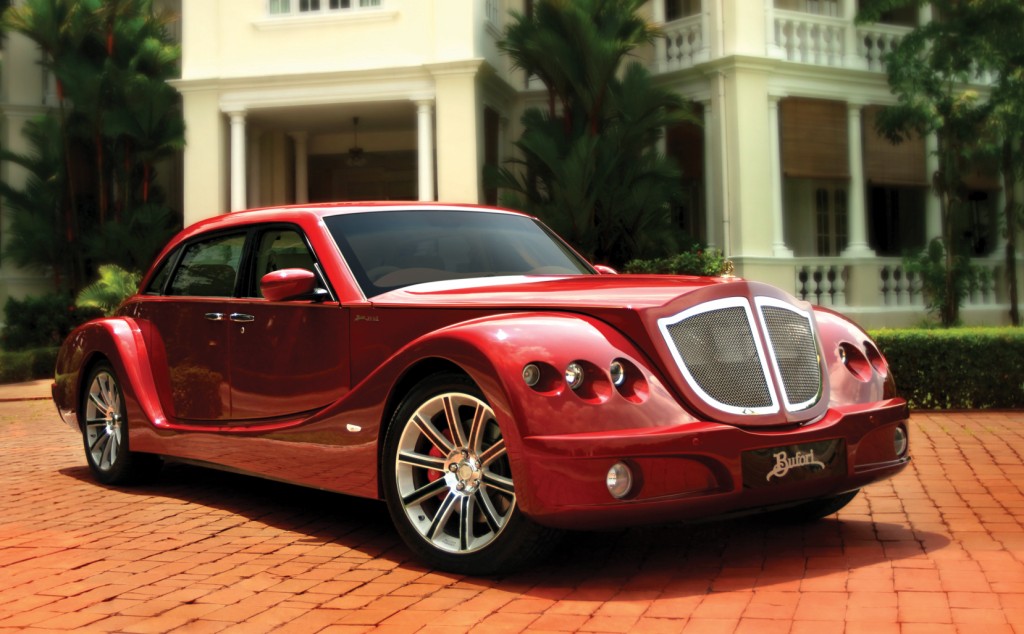
Is it classic? is it contemporary? I think so… because its  n
n
“Every five or so years, we might go to a motor show,” Gerry Khouri tells me, “but we probably don’t need to do that.” We are seated in a hospital-clean, funeral-quiet conference room furnished to a standard of chrome-and-leather minimalism that would make Ludwig Mies van der Rohe fidget. Below us, there is a factory about the size of your average Home Depot, in which the Bufori Motor Car Company makes the carbon-kevlar body of its Geneva ultra-luxury sedan, the stainless-steel frame on which it sits, and other components down to the circuit boards that control its unique and bespoke electronic functions. On the other side of the glass window in front of us is the frenetic hustle and bustle of a Malaysian industrial district, where the roads are filled to the brim with motorcycles, trucks, and draft animals.
You’ve never heard of Bufori, and that’s just fine with Khouri. His customers know who he is; he, in turn, knows them exceptionally well. After ensuring that this part of our conversation will be off the record, he gives me a few names and titles, mostly from the Middle East. It’s an impressive list, and it explains why Bufori is currently working on a backlog of orders that will take more than a year to complete at their current rate of 30 to 40 cars a year. Each one is made to order; the company does not build inventory for its dealerships. There isn’t even a precise agreement on what constitutes the “base-model” Bufori; no customer has ever foregone all the options. As I pore through the contents of a leather-bound briefcase containing hundreds of pearlescent pain samples, Khouri offers humbly, “we don’t really sell very many basic specification cars.”
In the beginning, mind you, Khouri didn’t want to sell any cars at all. It was 1986, and the three Khouri brothers were living in Australia. On a whim, Gerry decided to build a car for his own use. (How he acquired the resources to do this is a subject on which the man is politely but firmly nonspecific.) He was inspired by neoclassic cars like the Excalibur and Clenet that had made such a splash in Jimmy Carter’s America.
Like many of those neoclassics, his first effort featured an air-cooled VW drivetrain. Unlike the American builders, however, Khouri decided to fabricate the bulk of his car from scratch. That freed him from the constraints of an existing frame or body panels, allowing him to draw the car to his preferred proportions. The original Bufori is best described as the car that the Clenet wanted to be.
It was also the car that a surprising number of friends and acquaintances wanted to buy. So Khouri got serious, opening up a small production facility to build his designs in small batches and swapping the aircooled VW engine for a modern Subaru boxer. The next step was to find a new body material. “We needed something better than fiberglass,” he states, “something that other people couldn’t do, something that would give us an edge.”
That edge came courtesy of a unique material: Woven fabric that contained strands of both Kevlar and carbon fiber, shaped into body panels and then hardened with hot resin. “How did you even know about Kevlar at the time?” I ask. “How did you get it in bulk? Did you have contacts in the military or defense industries?”
“Oh, no,” Khouri responds with a smile. He offers no further details. Another decision taken around the same time: Shifting production to Malaysia. “I love it here,” Khouri tells me. “We have to work very hard to produce cars in Malaysia, it can be uniquely difficult. But I would not leave.” The conference room features a massive Malaysian flag; having been personally invited here by the government a few decades prior, Khouri is patriotic about his adopted country and takes considerable pride in his workforce, which consists mostly of Malaysians.
For about a decade, the definitive Bufori was the La Joya (“The Jewel”), a two-door hardtop neoclassic body rendered in Kevlar over a stainless-steel spaceframe with a transversely-mounted 2.7-liter V6 behind the seats. At Khouri’s urging, I take a seat behind the wheel of their La Joya demonstrator. It’s nearly a decade old and it’s been crashed twice, but it looks, smells, and feels like a brand-new car, having been periodically updated to current spec. The pearl-white paint has an unearthly glow. “Of course, we take real mother of pearl and crush it into the paint,” Khouri explains. “Each batch is therefore subtly different, and unique to the car for which it was intended.” The last time I saw an automotive finish of this quality, it was on a Rolls-Royce Corniche, laid down before today’s environmental regulations replaced those fine enamels and lacquers with today’s water-based, orange-peel mediocrities.
The La Joya’s interior is jarringly modern, with a wide variety of function switches and seat adjustments set side-by-side with 24 karat gold-plated instruments. Bufori says it offered Bluetooth communications before any German, American, or Japanese manufacturer, and the company prides itself on providing up-to-date electronics. There is a massive subwoofer mounted on the far side of a footwell grille. The leather has the feel and smell of the old Connolly Autolux hides from before the major automakers started plasticizing their cows.
There’s a lot to like about this car, including the stout running gear with its polished bespoke shock absorbers, Brembo brakes, and BBS cross-lace wheels. Yet at six-foot-two and 240 pounds I’m a bit cramped behind the wheel. Khouri explains to me that the La Joya has been very popular in the Chinese and Middle Eastern markets, particularly among women buyers, which perhaps explains the interior proportions. “The Geneva is different,” he promises.
And so it is. I do not know if you could describe this imposing, Phantom-meets-Mulsanne, suicide-door sedan as “handsome,” although I find it to be very impressive in person. The first example of the Geneva was commissioned by the family of a top-tier Malaysian businessman as a birthday gift; the factory stayed open 24/7 for three months to put it together in time for a very public unveiling. The response virtually guaranteed that the Geneva would become Bufori’s volume model.
(source: Road & Track)
CC2 Stats
Tier: 1
Token: 3
Price Range: 3B
Exclusivity: VIP
Scrap Limit: 4000